Spark Declarative Pipelines in Apache Spark 4.1: A Complete Guide
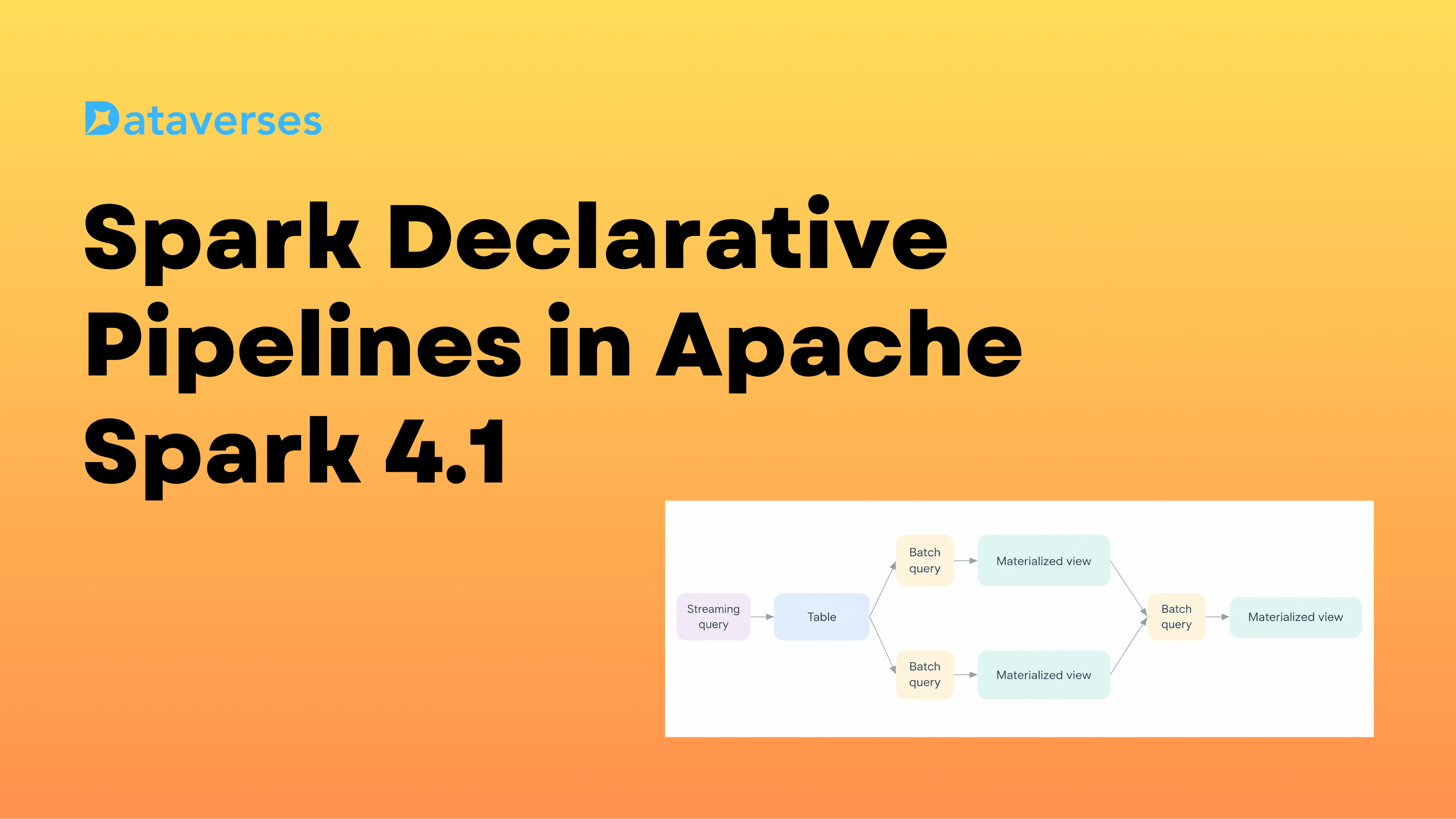
The release of Apache Spark 4.1.0 marks a significant paradigm shift for data engineers and SQL developers alike. Among the most anticipated additions is Spark Declarative Pipelines (SDP), a new native component introduced under the Spark Project Improvement Proposal SPIP-51727. Inspired by successful declarative design patterns like Delta Live Tables (DLT), SDP aims to remove the operational complexity of building, maintaining, and testing complex batch and streaming data pipelines.
By shifting from an imperative "how-to-process" mindset to a declarative "what-to-build" approach, Spark 4.1 modernizes development workflows across open data lakehouses.
The Core Philosophy: Shifting from Imperative to Declarative
Traditionally, building production-grade ETL pipelines in Apache Spark required writing explicit, step-by-step logic via the DataFrame API or Structured Streaming. Data engineers had to manually manage execution graphs, orchestrate dependency sequencing, configure state checkpoints, handle transient retries, and scale infrastructure.
With Spark Declarative Pipelines (SDP), these orchestration and compute management details are entirely abstracted away. Developers simply declare the desired target datasets, what tables should exist, and how data flows between them using standard SQL or PySpark. The underlying SDP engine automatically handles:
- Dependency Resolution: Generating the end-to-end Data Flow Graph and calculating the correct sequence of execution.
- Parallel Execution: Running independent data flows simultaneously when possible to maximize cluster utilization and reduce compute costs.
- Automated Fault Tolerance: Managing checkpoints, underlying state directories, and multi-level automated retries-starting from granular Spark tasks up to individual flows and entire pipelines.
Key Abstractions of SDP
At the heart of Spark Declarative Pipelines is the concept of a pipeline containing connected datasets. Within this graph, developers define and interact with three primary dataset abstractions:
- Streaming Tables: A combination of a table and one or more streaming flows written into it. Streaming tables support incremental data processing, ensuring that only new or modified data is processed as it arrives from message buses (like Apache Kafka, Amazon Kinesis, or Azure EventHub) or cloud object storage.
- Materialized Views: Precomputed views saved directly to physical storage for rapid downstream retrieval. A materialized view always has exactly one batch flow writing to it, which automatically updates contents using batch semantics to prevent expensive, repetitive re-computation.
- Temporary Views: Scoped strictly to the execution of the pipeline. These views act as intermediate logical blocks, helping encapsulate complex transformations that multiple downstream datasets rely on without writing intermediate data to disk.
Unified SQL and Python API Support
SDP democratizes pipeline development by allowing both SQL-focused analysts and Python developers to work seamlessly inside the same ecosystem.
The SQL Approach
For SQL-first environments, setting up an end-to-end incremental pipeline becomes as straightforward as executing DDL-like commands:
-- Step 1: Ingest raw data into a Streaming Table
CREATE STREAMING TABLE raw_orders AS
SELECT * FROM STREAM read_files("/volumes/raw/orders", format => "json");

-- Step 2: Build a precomputed Materialized View for downstream analytics
CREATE MATERIALIZED VIEW transaction_summary AS
SELECT customer_id, COUNT(order_id) AS total_orders
FROM raw_orders
GROUP BY customer_id;
The Python (PySpark) Approach
Python developers can leverage the new pyspark[pipelines] package, utilizing intuitive annotations and decorators like @dp.table to orchestrate flows:
from pyspark import pipelines as dp

@dp.table
def raw_orders():
    return spark.readStream.format("cloudFiles") \
        .option("cloudFiles.format", "json") \
        .load("/volumes/raw/orders")
Note: Python functions within SDP are evaluated multiple times during planning and should strictly return a Spark DataFrame without invoking manual .write() or .save() operations.
Pre-Validation and the Spark Pipelines CLI
One of the most powerful features of SDP is its tooling. Discovering graph or schema errors hours into a production pipeline run is heavily reduced through a dedicated command-line interface toolchain:
spark-pipelines init --name <pipeline_name>: Generates a boilerplate pipeline project layout, including a specification file and example configurations.spark-pipelines dry-run: A powerful pre-validation utility. It tests code syntax, identifies missing tables or columns, and catches graph validation errors (such as cyclic dependencies) or schema incompatibilities before reading or writing any physical data.spark-pipelines run: Deploys the pipeline to the cluster and continuously monitors execution progress, data flows, and performance metrics until completion.
Automated Data Quality (Expectations) and Enterprise Interoperability
Beyond simple data flow, SDP integrates data quality rules directly into the pipeline fabric using Expectations. Developers can declare data quality constraints to track trends and safeguard data integrity:
CREATE OR REFRESH STREAMING TABLE orders_clean (
    CONSTRAINT valid_order_id EXPECT (order_id IS NOT NULL) ON VIOLATION DROP
) AS SELECT * FROM STREAM raw_orders;
Through data quality violation policies like WARN, DROP, or FAIL, organizations can set explicit thresholds for bad data, or route flagged records into quarantine tables for asynchronous auditing and reprocessing.
Furthermore, while Databricks has extended this functionality into its performance-optimized runtime environment (via Lakeflow SDP), Apache Spark 4.1's open-source core seamlessly supports open storage formats-including Apache Iceberg and Delta Lake-and plugs directly into standard catalogs like AWS Glue or Unity Catalog.
Current Limitations of SDP
While Spark Declarative Pipelines mark a monumental leap forward in developer productivity, the framework in its early lifecycle comes with specific operational and technical constraints. Engineering teams evaluating SDP for production architectures should account for these current limitations:
-
Tight Lifecycle Coupling: Tables managed by SDP are heavily coupled to the lifecycle of the pipeline itself. If you delete or drop an SDP pipeline definition, the underlying Streaming Tables or Materialized Views it manages are automatically dropped as well. Migrating a table to a different pipeline requires explicit ALTER commands and mandates stopping the existing pipeline, introducing brief service interruptions.
-
Analytical and SQL Function Restrictions: Because SDP relies heavily on static graph planning and dry-run validation to catch errors before runtime, certain dynamic execution functions are unsupported. For example, the pivot() operation-which requires an eager, runtime scan of data to dynamically compute output schemas-conflicts with SDP's static parsing. Additionally, time-travel queries are currently unsupported on Materialized Views generated via SDP.
-
Execution and Scheduling Constraints: In the open-source version, pipeline execution triggers are largely restricted to AvailableNow (batch-style) or continuous execution. Triggering pipelines natively via explicit file-arrival events is not supported out of the box; developers must still rely on external orchestrators (like Apache Airflow) to handle complex event-driven scheduling. Furthermore, a pipeline dataset can generally be targeted by only one explicit pipeline graph; you cannot easily have multiple separate pipelines write into the exact same Materialized View target.
-
Limited Out-of-the-Box Observability: While SDP writes metrics to an internal system event log (accessible via manual event_log SQL queries), advanced enterprise observability features are still maturing. Native alerts for delayed row processing or automated SLA breach warnings currently require custom logging configurations or proprietary ecosystem extensions.
Conclusion
Spark Declarative Pipelines in version 4.1 represents a massive leap forward for data engineering efficiency. By minimizing the boilerplate infrastructure code traditionally required for streaming, checkpointing, and orchestration, SDP allows data teams to focus entirely on business logic. Whether you are an analyst writing pure SQL or an engineer constructing Pythonic workflows, SDP guarantees a faster, cleaner, and more reliable path toward building production-grade data lakehouses.
This video features an in-depth breakdown with core Databricks engineers discussing the challenges of traditional Spark orchestration and how the new declarative components in Spark 4.1 simplify debugging and pipeline validation.
Tags
Keep up with us
Get the latest updates on data engineering and AI delivered to your inbox.
Contents in this story
Recommended for you
Announcing Apache Spark 4.2.0: Geospatial Intelligence, First-Class CDC, DSv2 Transactions, and Arrow-Powered PySpark
Jul 27, 2026 · 6 min read

Code Smarter, Not Harder: Meet the New Notebook Code Generation on Dataverses
May 23, 2026 · 4 min read
Apache Iceberg 1.11.0 Release: Deletion Vectors, Variant Type, and V3 Maturity
May 22, 2026 · 7 min read